

BY MIKEL AGIRREGABIRIA – TECHNICAL MANAGER, ULMA-SPAIN
The technical logic of a roller is straightforward: a shaft, bearings, and a shell rotating around that shaft. The problem is that, in heavy-duty mining, making sure that logic holds up in the field for years is anything but simple.
In Canada, it is common to face highly demanding operating conditions: extreme cold, abrasive dust, sticky material, impacts, and often several of these factors at the same time.
And when all of that comes into play, the difference between a roller that turns and one that keeps turning reliably over the long term does not depend on a single variable. It depends on how critical points in design, manufacturing, and validation are resolved.
“When we talk about reliability, what really matters is understanding what is stressing the system, and which design, manufacturing, and validation decisions can sustain its field performance”.
One of these critical points is the sealing system. When water, fine dust, or humidity are involved, any failure in bearing protection accelerates degradation. Under these conditions, sealing performance depends on how multiple protection levels are engineered: labyrinth geometries, contact elements, and grease-lubricated barriers capable of preventing the ingress of water and particles, promoting contaminant expulsion, and reducing the risk of freeze-up during downtime or degradation in fine dust environments.
This design logic is what allows a roller to start rotating again after 30 days of downtime at -50 ºC, or to dramatically extend service life in extremely abrasive environments.
Another aspect that is often underestimated is the roller’s internal geometry. Here, every millimeter determines how the system behaves under load. The greater the distance from the support point, the greater the shaft deflection and the poorer the long-term performance of the assembly. Reducing that lever arm improves stiffness, lowers vibration and bearing micro-impacts, and helps increase durability.
Not long ago, we came across one of our rollers on an iron ore shiploader conveyor. It has been withstanding impacts, start-ups, and shutdowns for 40 years. A powerful reminder of why every millimeter needs to be exactly where it belongs.
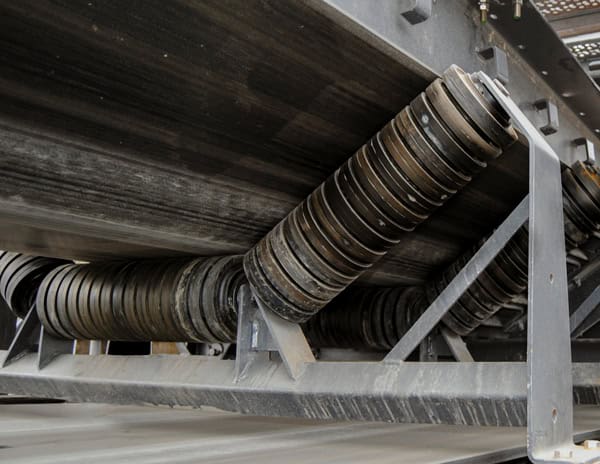
Added to this is a fundamental issue: design alone does not guarantee field performance. A solution may be perfectly engineered on paper and still lose reliability if the manufacturing process does not maintain the parameters that solution requires. Roundness, coaxiality, weld quality, wall thickness control, and dimensional stability are not secondary issues — they determine whether the roller’s real-world behavior matches what was intended in the design phase.
That is why, when discussing reliability, it is not enough to compare materials or dimensions. What truly matters is understanding what is actually stressing the system and which design, manufacturing, and validation decisions can sustain its field performance. That is the point where technical logic stops being a hypothesis and becomes a result.
It is also only logical that the most effective solution cannot be proposed without understanding the system first. So, if you are planning to attend the Saskatchewan Mining Supply Chain Forum o CIM Connect in Canada, we would be glad to meet you there. It will be a great opportunity to discuss these topics — or any others that bring us closer to the reality of your operation.
If you are unable to visit our booths, we would be happy to connect with you here.
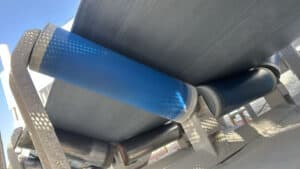
In OIL SANDS, the sealing system is where THE REAL BATTLE begins. Are you READY?
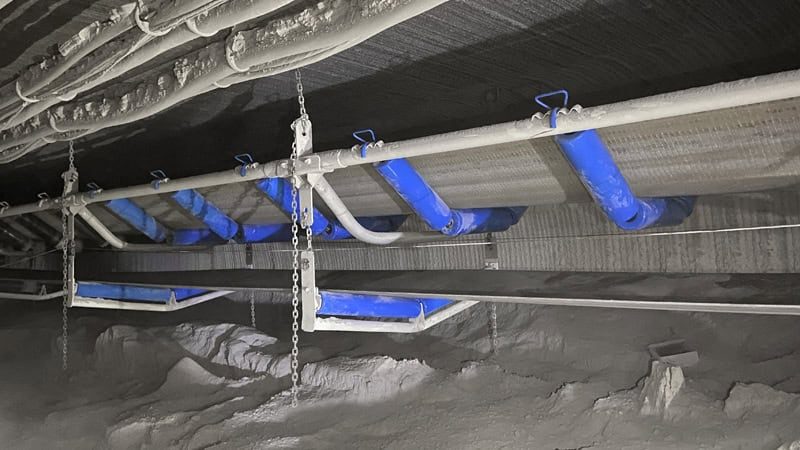
FINE ABRASIVE DUST is one of heavy-duty mining’s “FINAL BOSSES”. At least until it runs into ULMA rollers…