

Javier Moreno
Quality Manager
In Heavy Duty mining, everything starts with a calculation: loads, speed, bending, distance between support points or operating conditions. But calculations do not work in the mine. The real component does. And what matters is that it performs as expected, again and again.
Dimensional control, materials, trackability, assembly processes, testing, and, of course, field trials are what validate the calculations and designs.
Verifying reliability
We know that one of the key factors that define the reliability of ULMA rollers against abrasive dust is their sealing system: four barriers that act sequentially to stop and expel any dust particle or water before it reaches the bearing.
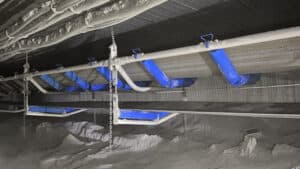
Underground copper mine. Chile.
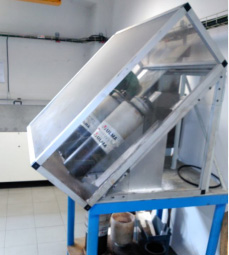
But we also know that theory can support everything. That’s why, when we talk about the reliability of the ULMA sealing system against dust particles, we do so knowing that after more than 72 hours rotating at 600 rpm, with the rollers leaning at 45º inside a housing with contaminant material, the protection barriers perform their function and the bearing remains protected.
“In the field, manufacturing reliability means that, in an underground copper mine in Chile, an ULMA roller has multiplied its usual service lifetime by 8, so far”.
In an area where rollers used to last no more than three months due to the presence of highly abrasive dust, ULMA roller is still operating after 2 years.
The sealing system responds. We know this from this mine in Chile, but also from many others in Peru, Morocco, and Finland.
The same Logic applies to ULMA COMPOSITE
Something similar happens with composite rollers.
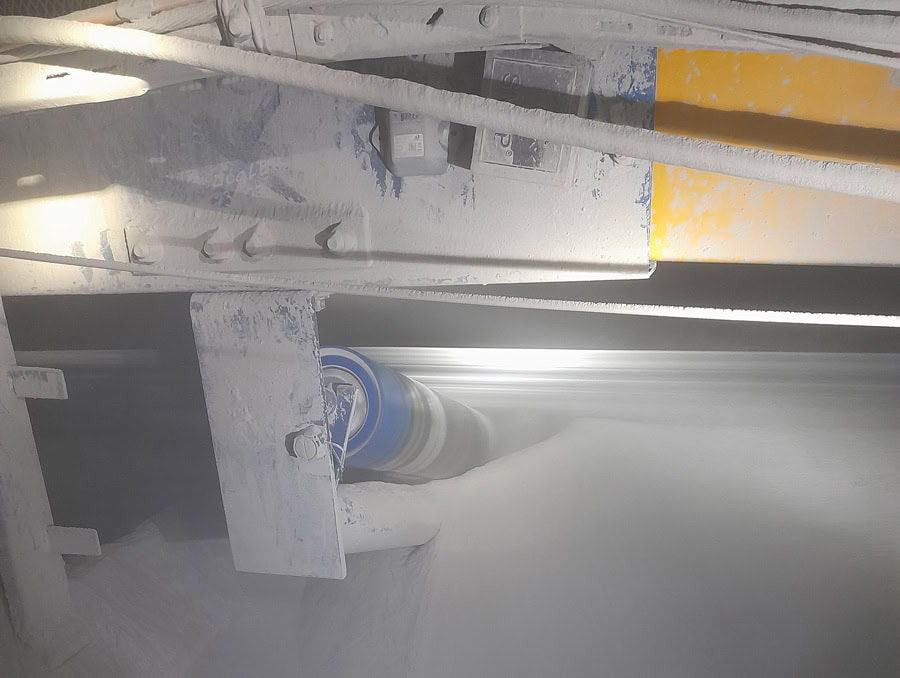
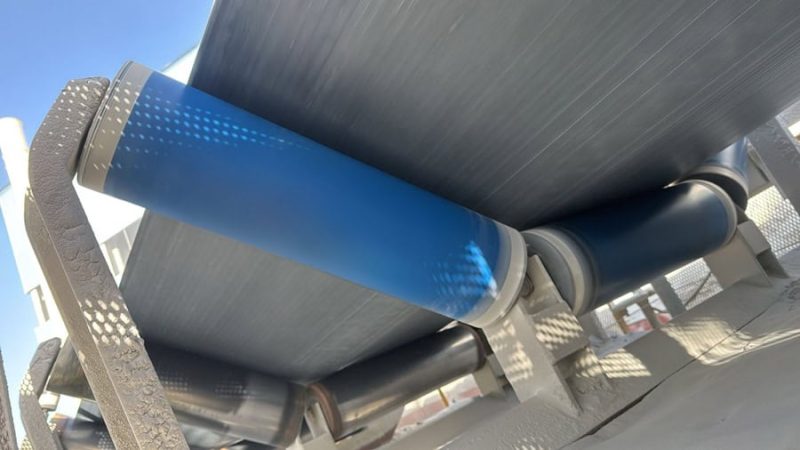
Mina de cobre subterránea. Chile.
Their most visible advantage is weight reduction, which makes handling easier during maintenance tasks. But in Chilean mining, where high tonnages and impacts set the pace for conveyors, structural performance is a must.
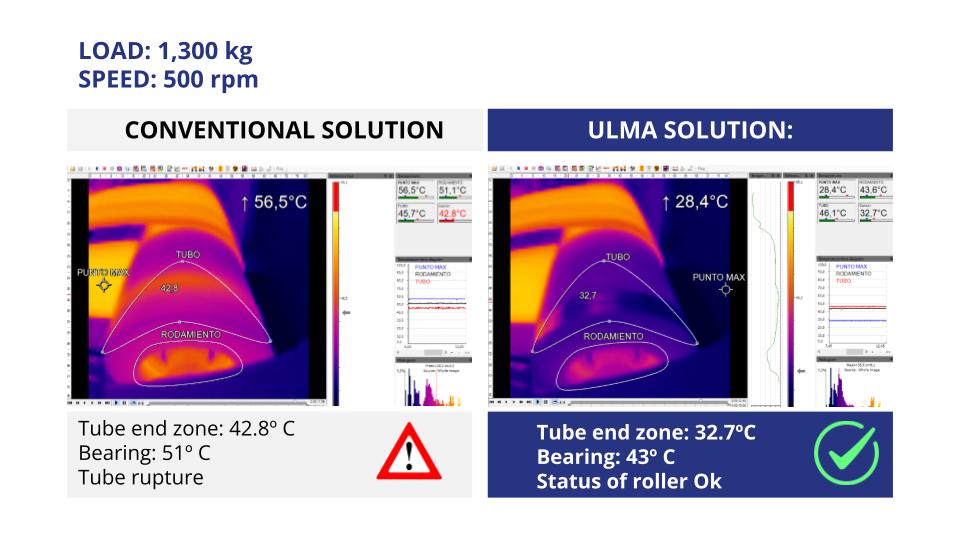
That is why ULMA’s proposal is a very lightweight roller, yes, but with the bearing protection, stability, and load capacity of a metal roller. A roller manufactured with the same structural logic, geometry, joint between housing and tube, thermal behavior, and validation under stress. A logic that the laboratory has put to the test once again, proving that ULMA composite maintains better structural integrity and thermal stability under load than a conventional solution.
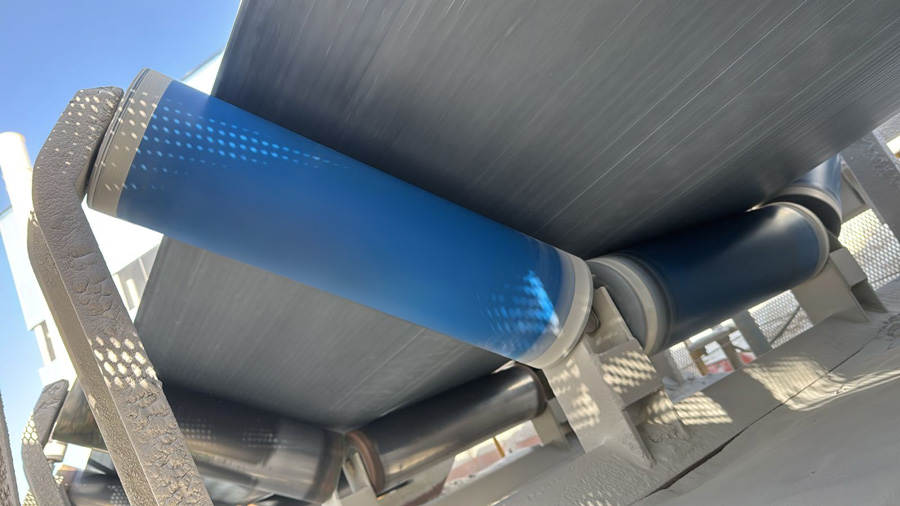
Coal mine. Indonesia.
And if laboratory tests already show differences, the field confirms them. In a coal mine in Indonesia, ULMA composite rollers operate at a belt speed of 9 m/s and handle 8,000 t/h of material. This demanding application proves that the lightness of ULMA composite is not at odds with load-bearing capacity or reliability in actual operation.